
Loading...
Serving Napa, CA and surrounding areas. (707) 254-6177
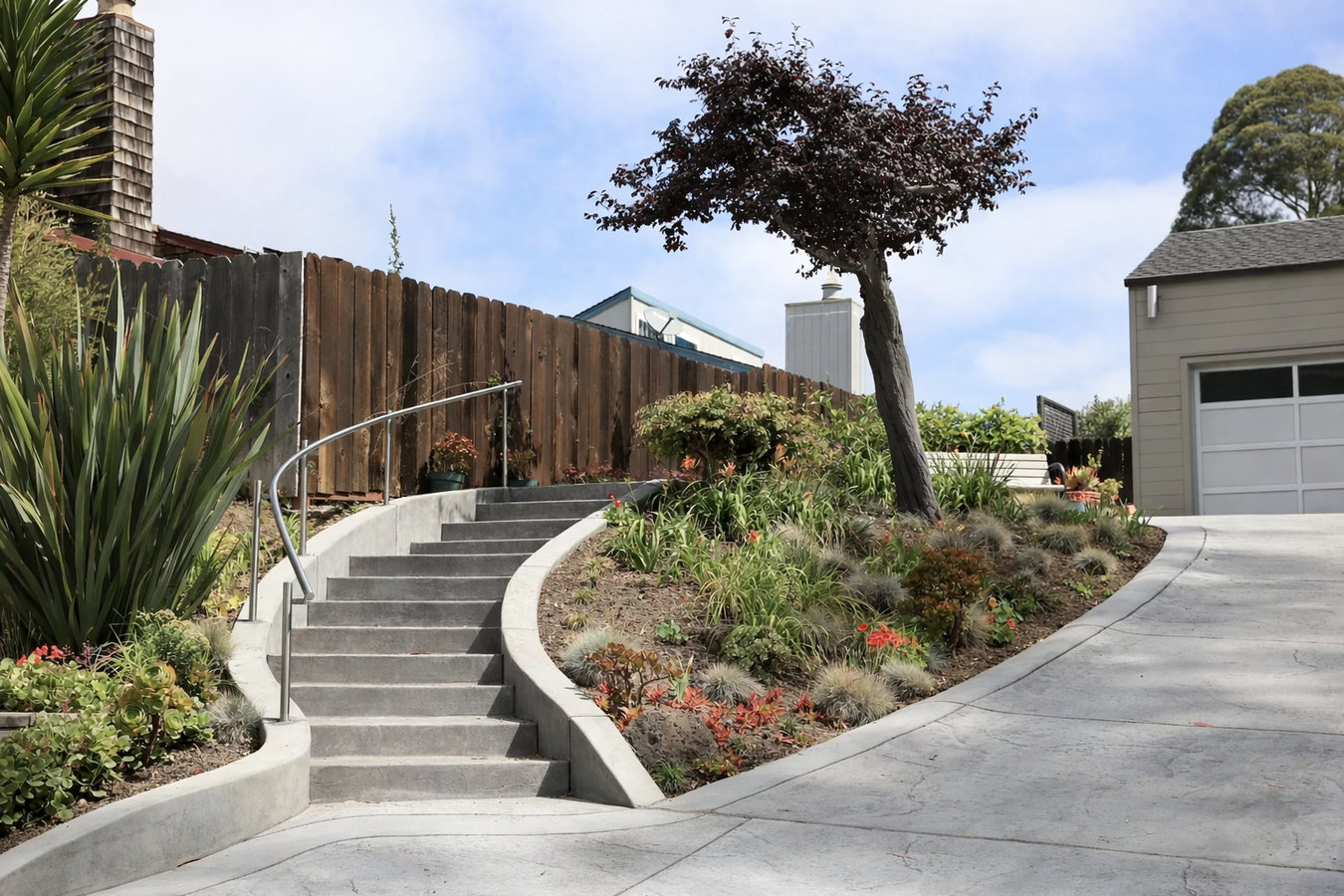
Crumbling, tilting, or slippery entry steps are a safety hazard and a poor first impression. We build concrete steps in Napa that stay level through clay soil movement, grip wet feet after winter rain, and fit the style of your home.
Concrete steps construction in Napa involves removing old steps if needed, preparing a compacted gravel base, building wooden forms, pouring reinforced concrete, and finishing the surface for grip - most projects take one to two days of active work with a few additional days for curing before full use.
A lot of homes in Napa were built in the mid-20th century, and many original entry steps from that era are now crumbling, too narrow, or sitting on ground that has shifted over decades of wet winters and dry summers. The clay-heavy soils common throughout the Napa Valley are the main culprit - they swell when rain soaks in and shrink back when summer arrives, and steps poured without a proper gravel base underneath move with that soil cycle until they crack or tilt. We address the base before we build the form, which is the difference between steps that hold up for decades and steps that need attention again in a few years.
If the area around your entry also has a grade change that needs to be managed, we often discuss concrete retaining walls at the same time, since both projects address related drainage and soil movement issues at the front of a property.
If chunks are breaking off the corners of your steps, or the surface is peeling away in patches, the concrete has reached the end of its useful life. This kind of breakdown gets worse quickly once it starts, and patching rarely holds for more than a season or two in Napa's wet-dry climate cycle. Replacement is usually the more cost-effective choice at this point.
If a step feels uneven underfoot, or if you can see a visible tilt when you look at the steps from the side, the base underneath has likely shifted. In Napa, this is often caused by clay soils expanding and contracting through wet and dry seasons over many years. A tilted step is a trip hazard that warrants prompt attention.
If standing water collects where your steps meet the walkway after a winter rain, drainage around the steps is not working correctly. Over time, that pooling water works its way under the steps and accelerates the soil movement that causes cracking and tilting. This is a common issue in Napa neighborhoods where original landscaping has settled or changed over the decades.
Older homes in Napa - particularly those built before the 1970s - often have entry steps built to standards that feel awkward by today's expectations. If you find yourself turning sideways to carry groceries in, or if guests comment on the steepness, the steps were likely not built to current safety guidelines. New steps can be designed wider and with a more comfortable rise height.
We handle everything from demolition of your existing steps through forming, pouring, and finishing. We use steel reinforcement inside every pour - rebar or wire mesh depending on the size of the project - because Napa is in an active seismic zone and steps that cracked after the 2014 earthquake typically lacked internal reinforcement. We compact a gravel base before building the form, which is the most important thing we do to protect your investment against the clay soil movement common throughout the Napa Valley. The slab foundation approach we use for ground preparation applies to steps just as it does to larger pours - a stable base is non-negotiable in this soil.
Surface finish options range from a simple broom texture - the safest and most practical choice for wet Napa winters - to stamped patterns and exposed aggregate that give your entry the character of your home's architecture. We handle the City of Napa permit from application to final inspection so you never have to visit the building department or figure out the process yourself. A written estimate covers every line item before work begins.
Full removal of old steps and installation of new reinforced concrete steps - the most common request from Napa homeowners.
Building steps where none existed before, including base excavation, gravel prep, and forming to the correct rise and run.
Textured surface that grips wet feet - the practical standard for Napa homes that see concentrated winter rainfall.
Patterned or exposed-aggregate finish for homeowners who want the entry to reflect the character of their home.
Wider stair designs with intermediate landings for front entries that need to accommodate multiple people or accessibility needs.
Combined step and wall scope for entries where a grade change and stair approach need to be solved together.
Napa receives most of its rainfall between November and March, and fresh concrete needs to be protected from heavy rain for at least the first 24 hours after it is poured. Most local contractors prefer to schedule pours in the dry season, roughly April through October, to avoid rain delays and surface damage. The seismic context also matters here. The 2014 South Napa earthquake was a reminder that ground movement is a real local risk, and steps that cracked or shifted after that event typically had two things in common: no internal steel reinforcement and a base that was not compacted correctly. Both are problems we build against on every project we take on in this area.
We work on entry steps throughout the region, from older Victorian-era homes in Napa to mid-century ranch homes in Fairfield. Both areas share the same clay soil conditions and the same pattern of older steps that were poured without the base preparation or reinforcement that makes concrete steps last.
We respond within 1 business day. Tell us how many steps you have, whether you are replacing existing steps or building new, and what size the entry is. We schedule a free on-site visit to measure and give you a written estimate - no pressure to decide on the spot.
Your estimate includes demo, base prep, forming, pour, surface finish, and the City of Napa permit fee. If a permit is required, we handle the application for you. We let you know the permit number once approved so you can track it yourself.
On the first day of work, the crew removes your old steps with a jackhammer - noisy for a few hours but usually done by mid-morning. After the old material is hauled away, we compact the soil and add a gravel base to give the new steps a stable foundation.
We build the wooden form, pour the concrete, finish the surface with your chosen texture, and protect the fresh concrete while it cures - typically three to seven days before normal use. We return for the city inspection, then do a final walkthrough with you before closing out the job.
Free on-site estimates, full permit handling, and a written quote before any work begins. We respond within 1 business day.
(707) 254-6177Every set of steps we build includes internal steel reinforcement. This matters in Napa because the 2014 earthquake and the area's active fault systems are a real local context. Unreinforced concrete steps are the ones that crack and shift after ground movement - reinforced ones hold.
We manage the permit application, coordinate with the City of Napa Building Division, and handle the final inspection. You get a fully documented, city-approved project that never creates a problem when you refinance or sell your home.
California requires any contractor doing work over $500 to carry an active state license. Ours is verifiable on the California Contractors State License Board website in about 30 seconds. We also carry liability insurance and workers compensation - ask for certificates before any work begins.
We have completed step replacement projects across 12 communities in the North Bay and Sacramento Valley region - all with the same clay soil challenges and similar older housing stock that Napa homeowners face. That breadth of local experience shows in how we prepare and build.
The combination of steel reinforcement, a properly compacted gravel base, and full permit documentation means every set of steps we build is designed for Napa's actual conditions - not just poured and left. That is the difference between entry steps that last 30 years and ones that need attention again in five.
For guidance on seismic considerations for concrete construction, the U.S. Geological Survey publishes earthquake hazard maps and background on North Bay fault activity. For California contractor licensing, visit the California Contractors State License Board.
When your entry steps connect to a slab foundation, both projects can be scoped together for consistent base preparation and a single permit process.
Learn moreRetaining walls often pair with entry steps on Napa hillside lots where grade changes need to be managed at the same time as the stair approach.
Learn moreCrumbling or tilting steps get more dangerous with every winter rain - contact us now for a free on-site estimate and a written quote with no obligation.